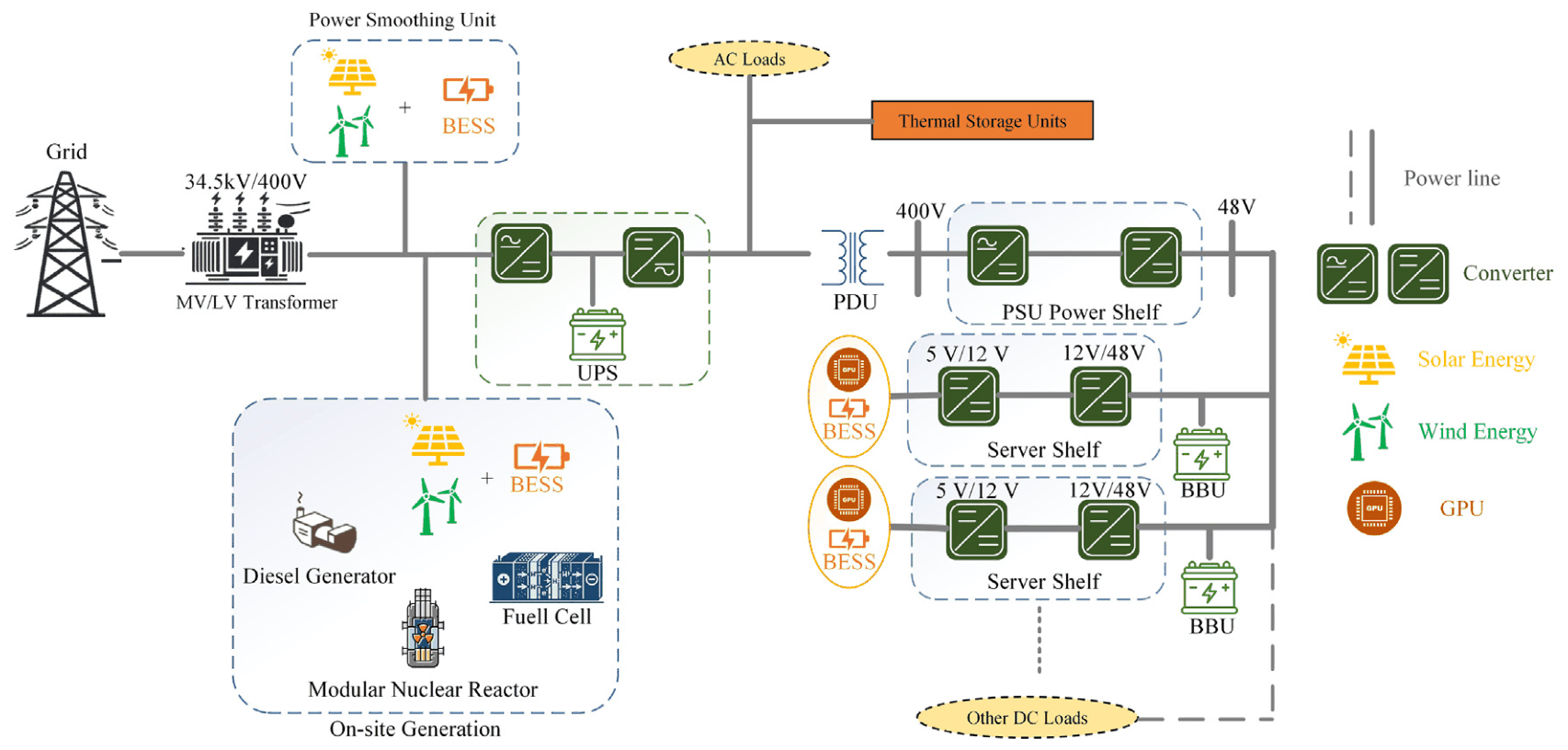
Figure 1. Overall architecture of an AI data center with hierarchical energy storage, from rack-level battery backup units to grid-scale storage and on-site generation.
Source: Advances in Applied Energy, 2026.
AI data centers are the fastest-growing loads on the grid, and their power profiles are highly dynamic and hard to forecast. This project develops hosting-capacity and reliability frameworks that quantify how much of this demand distribution and transmission networks can absorb, and designs grid-aware load-coordination and energy-storage strategies that expand hosting capacity without eroding reliability.
In a critical review published in Advances in Applied Energy, we organized energy-storage options for AI data centers into a four-layer hierarchy: chip-level buffering, rack- and server-level storage, facility-level uninterruptible power supplies, and grid-scale battery storage, supplemented by fuel cells and thermal storage. Each layer is characterized by its response timescale, ratings, operational role, and coordination requirements. Grid-interactive UPS systems emerge as the key evolution from passive backup to active grid support (frequency regulation, fast frequency response, and voltage ride-through), and second-life batteries as a cost-effective route to large-scale deployment.
A companion timescale-based review of AI data-center load modeling is under review at Applied Energy.
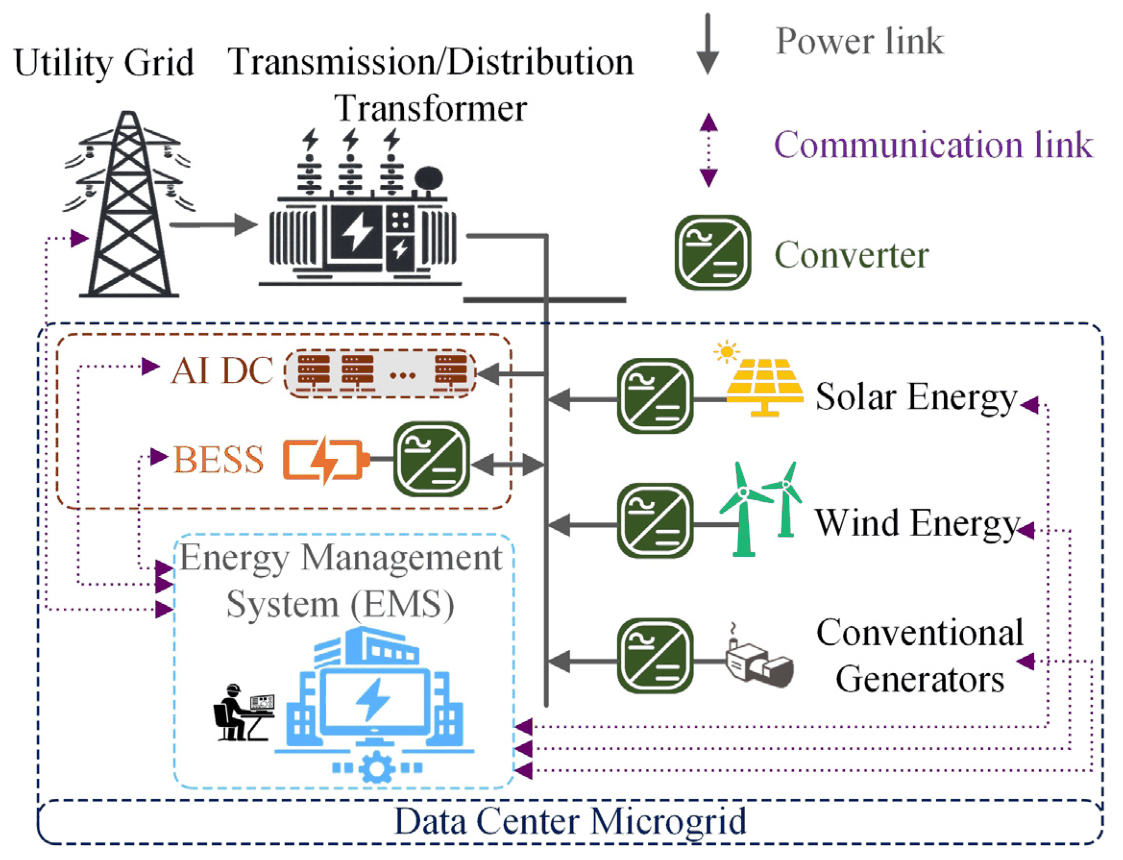
Figure 2. An AI data-center microgrid with coordinated storage, generation, and energy management.
Source: Advances in Applied Energy, 2026.
Artificial intelligence (AI) is driving unprecedented growth in data center (DC) scale and power demand. AI workloads impose highly dynamic, difficult-to-forecast power profiles on the utility grid, creating reliability and stability challenges that conventional DC architectures are not designed to address. This paper provides a critical review of energy storage systems (ESSs) as the key enabling technology for reliable grid integration of AI DCs. We organize the review around a four-layer hierarchical taxonomy, namely chip-level buffering, rack/server-level ESSs, facility-level uninterruptible power supply (UPS) systems, and grid-scale battery energy storage systems (BESSs), supplemented by non-battery technologies including fuel cells (FCs) and thermal energy storage (TES). Each layer is analyzed with respect to response timescale, power and energy ratings, operational role, integration challenges, and coordination requirements. Grid-interactive UPS (GiUPS) systems are examined in depth as a critical evolution of passive backup infrastructure into active grid-support assets capable of frequency regulation, fast frequency response, and voltage ride-through. Grid-scale BESSs are reviewed for their roles in peak shaving, renewable integration, and ancillary service provision. Second-life battery energy storage systems (SLBESSs) are evaluated as a cost-effective alternative for large-scale deployment. Key findings include: (i) AI DC load profiles differ fundamentally from traditional loads in their sub-second variability, making conventional ESS dispatch strategies insufficient; (ii) hierarchical, coordinated ESS deployment across all layers is necessary for effective load smoothing and grid support; and (iii) significant gaps remain in simulation tools, degradation modeling, load forecasting, and optimal multi-layer sizing. This review identifies open research challenges and future directions at the intersection of AI computing infrastructure and power system integration.