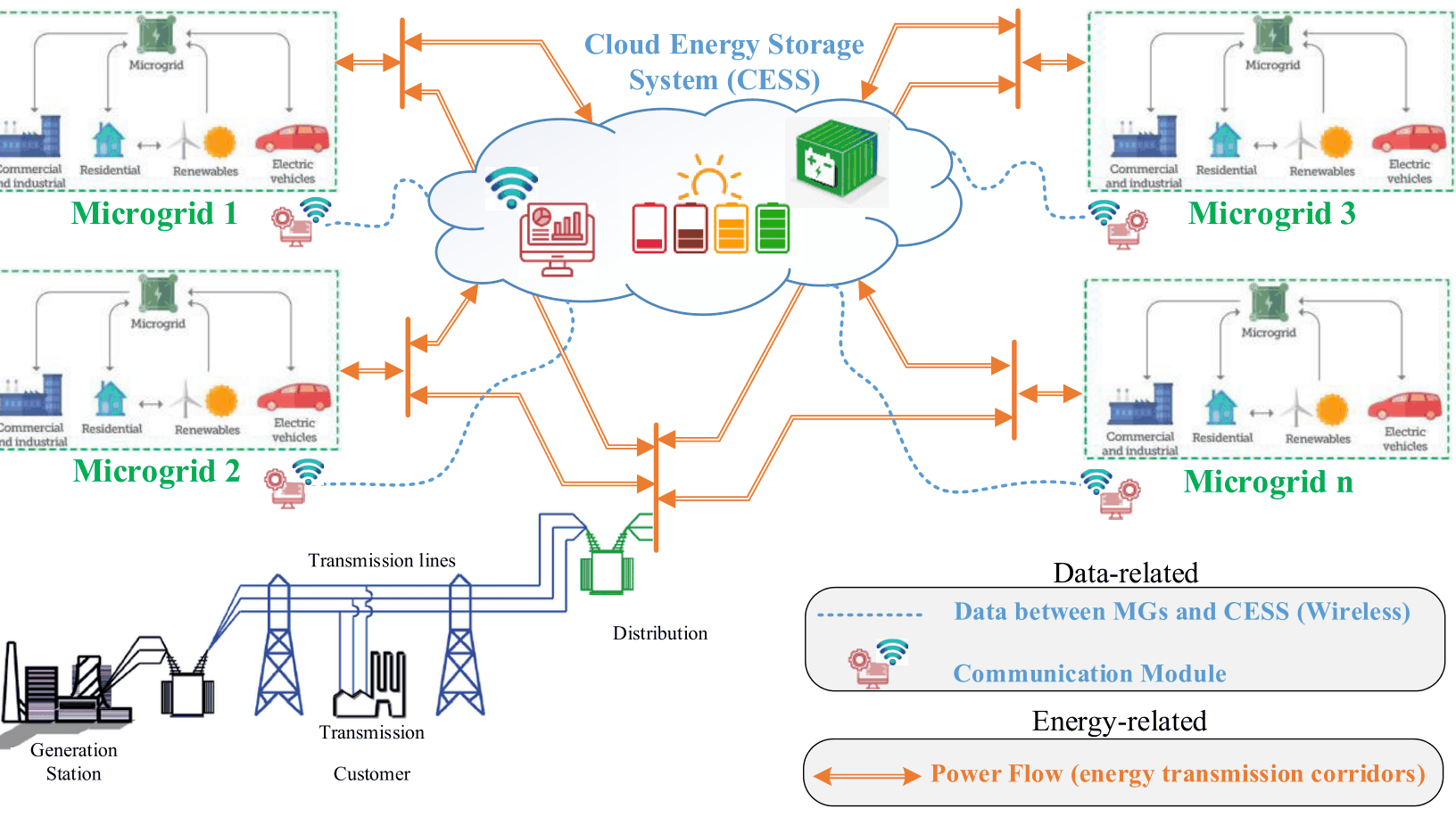
Figure 1. Cloud energy storage shared by several microgrids, with the data and power links between the microgrids, the storage pool, and the upstream grid.
Source: IEEE Access, 2023.
Grid-scale storage is often too expensive for a single microgrid. This project studies cloud and community energy storage: a shared storage pool that neighboring microgrids invest in and operate together.
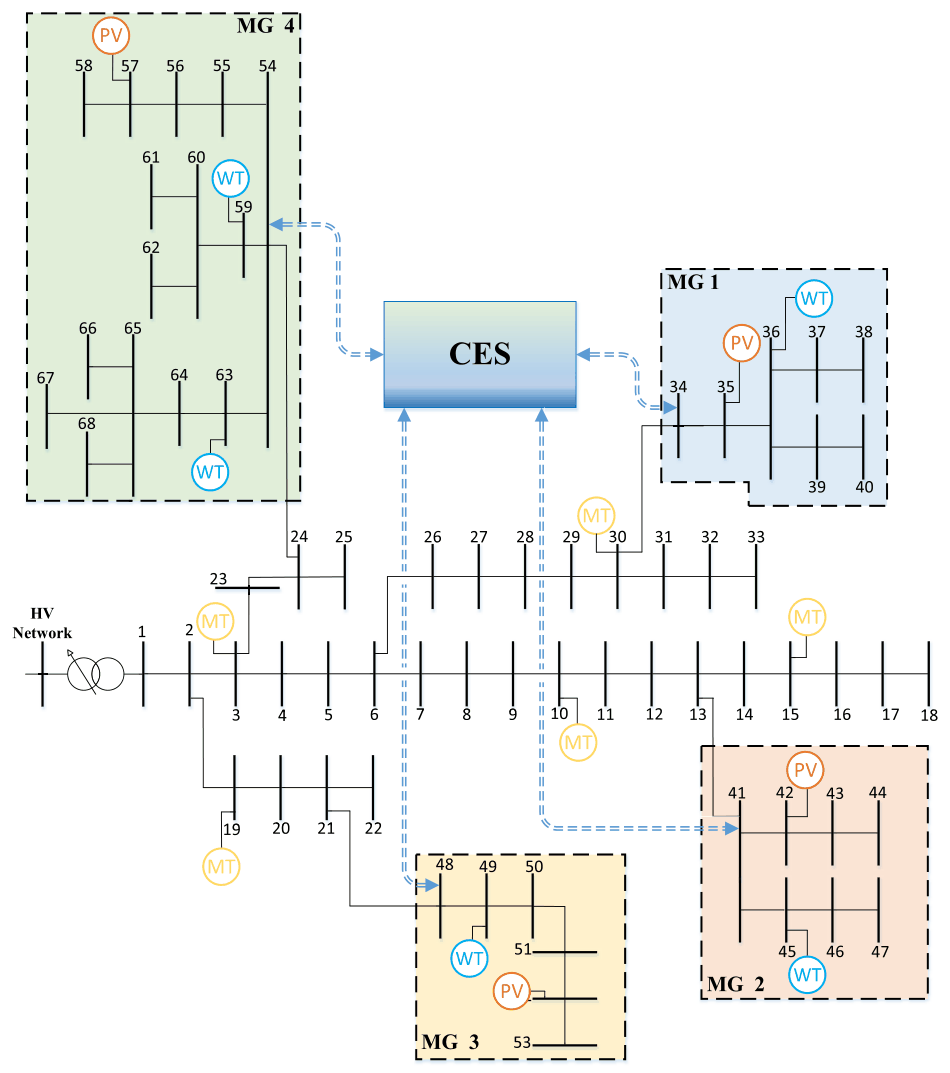
In IEEE Access we proposed a collaborative framework in which microgrids form a multi-microgrid to install shared cloud energy storage. Investment scenarios are compared by profit, expected energy not supplied, and a yearly reward from the transmission and distribution system operators for peak shaving and operating-cost reduction, and the microgrids pick a scenario through multi-attribute decision-making. The case study shows higher economic value for the investment, better reliability across the multi-microgrid, and effective peak shaving.
In a companion paper, a community energy storage connected to four microgrids is scheduled with the teaching–learning-based optimization algorithm to cut the microgrids’ energy costs, while the distribution system operator buys charged power at a premium during congested hours to relieve congestion. Monte Carlo simulation handles the uncertainty in load and renewable generation. Earlier conference work examined how congestion changes the optimal sizing of distributed generation in an active distribution network.
Figure 2. Test distribution system with four microgrids and the shared cloud energy storage.
Source: IEEE Access, 2023.
R. Haghighi, S. H. Jalalzad Mahvizani, M. R. Salehizadeh, H. H. Alhelou, and P. Siano
Journal article · IEEE Access, vol. 11, pp. 23808–23826, 2023
Abstract
A shared pool of grid-scale storage resources called Cloud Energy Storage (CES) can bring substantial benefits to the economical and reliable operation of MGs. However, the investment cost of CES may not be affordable for a single microgrid (MG). As a solution, we propose an approach in which neighboring microgrids in a distribution network collaborate and form a multi-microgrid (multi-MG) to install a shared CES to increase their profit and improve their reliability. Different investment scenarios are evaluated by considering the yearly reward from TSO and DSO. For each of the investment scenarios, TSO and DSO give a yearly reward based on the contribution of CES in peak-shaving and distribution network operation yearly cost reduction. Afterward, a decision table is provided in which, for all investment scenarios, profit, reliability index based on expected energy not supplied (ENS), and TSO-DSO yearly reward are determined. Finally, the microgrids select one of the investment scenarios using a multi-attribute decision-making approach. Simulation results of a case study validate the effectiveness of the proposed collaborative decision-making framework in increasing the economic value of CES investment, reliability enhancement in multi-MG, and peak-shaving.
S. H. Jalalzad, M. R. Salehizadeh, and R. Haghighi
Journal article · International Journal of Research and Technology in Electrical Industry, vol. 2, no. 2, pp. 166–175, 2023
Abstract
In recent years, active distribution systems have been exposed to congestion more than in the past, and different congestion management mechanisms have been investigated in the literature. Adopting a sharing framework for energy storage systems (ESSs) to deal with the long pay-back period and high investment cost of distributed energy resources (DERs) can bring a promising solution for relieving congestion. In this paper, a framework for simultaneous energy cost optimization and congestion management by using community energy storage (CES) is proposed. As a case study, a CES within a distribution system, connected to four microgrids (MGs), is considered. The shared storage system enables the MGs to reduce their energy costs by optimizing the operation of the battery using a heuristic optimization algorithm, specifically the teaching-learning-based optimization (TLBO) algorithm. Simultaneously, the distribution system operator (DSO) leverages the shared storage to alleviate congestion by purchasing charged power from the CES manager. In the proposed approach, the DSO pays a premium price for the charged power from the CES, surpassing the prevailing electricity price during congested hours. Moreover, to manage uncertainties arising from load variations and intermittent renewable energy resources (RES), Monte Carlo simulation is employed. Through comprehensive simulations and analyses, the proposed approach demonstrates the potential of CES as an effective tool for congestion management and operational cost optimization in distribution systems, providing economic benefits to both the MGs and the DSO.