Resilience of Distribution and Interdependent Infrastructure
Reliability & Resilience
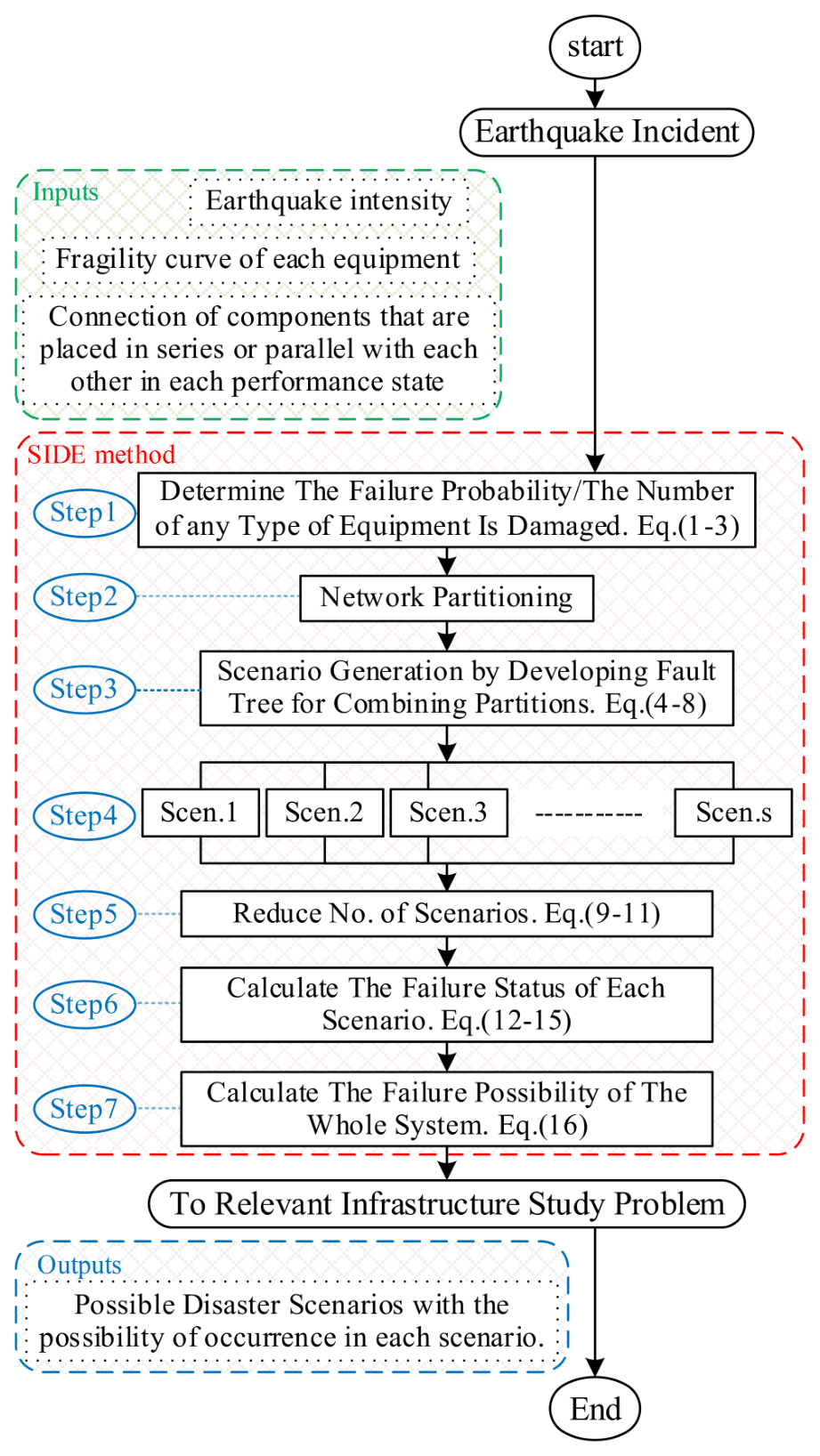
Figure 1. The Stochastic Infrastructure Damage Evaluation (SIDE) method: from fragility curves and network partitioning to scenario generation, reduction, and the failure probability of the whole system.
Source: IEEE Transactions on Power Delivery, 2024.
Earthquakes, storms, and floods damage distribution networks and the infrastructures that depend on them. This project quantifies that damage and finds cost-effective ways to limit it.
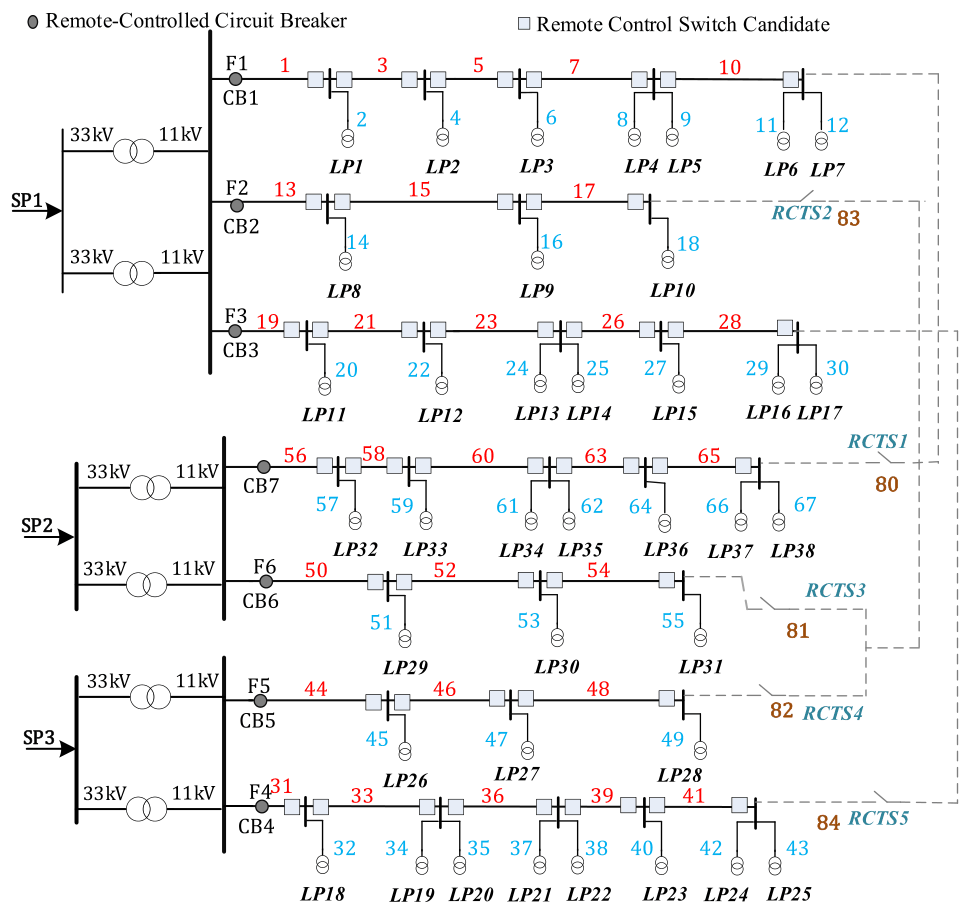
In IEEE Transactions on Power Delivery we proposed the Stochastic Infrastructure Damage Evaluation (SIDE) method, a partition-based event-tree approach that combines fragility curves with reliability block diagrams to estimate cumulative damage from a disaster. Partition-based modeling replaces traditional series equipment sets, and unlikely scenarios are pruned for efficiency. Applied to the RBTS bus 4 system under an earthquake scenario, SIDE matched Monte Carlo simulation, and sensitivity analysis over disaster severity and budget showed that beyond a certain budget the optimal locations of remote-controlled switches stop changing.
Ongoing work extends the approach to resilience assessment and enhancement by remote-controlled switch placement in distribution systems (under review at IEEE Transactions on Reliability) and to the electricity, water, and transportation nexus, with a GIS-aware logistics framework for last-mile delivery of solar relief packs (under review at IEEE Transactions on Smart Grid).
Figure 2. Single-line diagram of the RBTS bus 4 test system with candidate locations for remote-controlled switches.
Source: IEEE Transactions on Power Delivery, 2024.
A. Shahbazian, A. Fereidunian, S. D. Manshadi, and R. Haghighi
Journal article · IEEE Transactions on Power Delivery, vol. 39, no. 3, pp. 1575–1587, 2024
Abstract
Natural disasters like earthquakes, storms, and floods have an adverse impact on the critical infrastructures operation. The severity of the occurred damages on the infrastructure can be assessed by failure probabilities using fragility curves. In this paper, a Stochastic Infrastructure Damage Evaluation (SIDE) method is proposed. SIDE is a partition-based event tree approach. It estimates cumulative damage from disasters on distribution systems. The system is broken down based on equipment damage levels. SIDE evaluates the probability of damage in each partition. It uses reliability block diagram and the fragility curves of its components. The method improves event tree analysis by using partition-based modeling instead of traditional series equipment sets. Additionally, it enhances analytical efficiency by ignoring unlikely or non-expecting scenarios from the partition-based event trees (PBET). The method was applied to a power distribution system (RBTS4) as a critical infrastructure under an earthquake scenario, with results compared to Monte Carlo simulations (MCS). Finally, the merit of the proposed method is illustrated using sensitivity analysis, considering changing disaster severity and budget. The paper highlights a key observation, where in most budget allocation scenarios, the location of switches often overlaps. This suggests that beyond a certain budget, the SIDE method stops adding more switches.