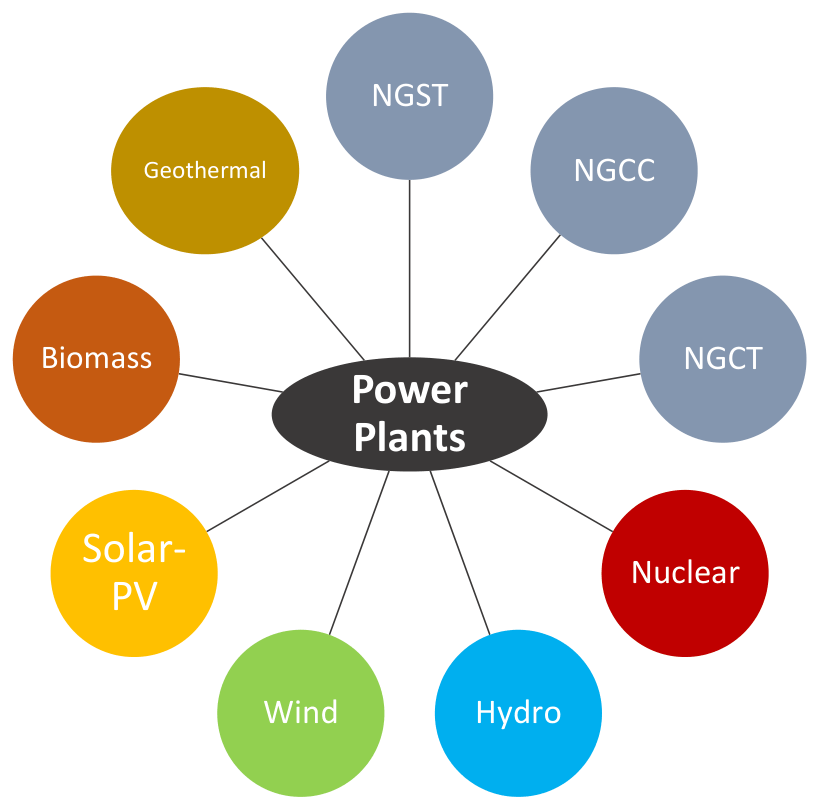
Figure 1. Candidate power-plant technologies in the generation expansion game, from gas turbines and nuclear to wind, solar, hydro, biomass, and geothermal.
Source: Computers & Industrial Engineering, 2021.
Long-term generation expansion planning (GEP) decides which plants to build and when, and carbon policy changes the answer. This project, carried out during my M.Sc. at Amirkabir University of Technology, modeled GEP as a game among power plants under government regulation.
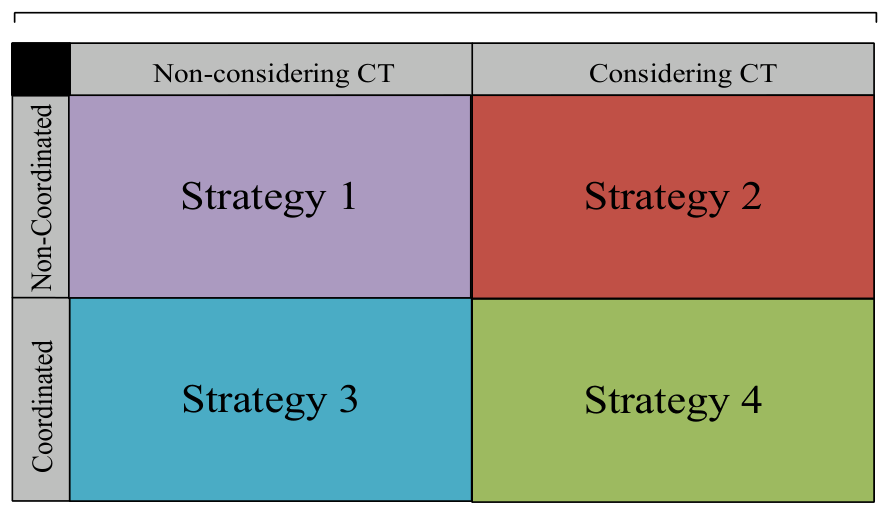
In Computers & Industrial Engineering we formulated GEP with a game-theoretic approach that includes a carbon tax and a government subsidy, compared four strategies for carbon reduction on an Iranian case study, and ran a sensitivity analysis on the tax and subsidy levels.
In Energies we solved each player’s expansion problem with the teaching–learning-based optimization (TLBO) algorithm, compared it with other metaheuristics, and developed a combined algorithm that reaches the Nash equilibrium among competing plants. Three scenarios evaluate the government’s role in reducing carbon emissions.
Figure 2. Four strategies under government regulation: with and without a carbon tax, and with coordinated or non-coordinated players.
Source: Computers & Industrial Engineering, 2021.
Global warming and climate change caused by human activities are some of the major environmental problems that the most important cause of this phenomenon is greenhouse gases, especially CO2. Due to the many consequences of this global phenomenon in the last two decades, the attention of many scientists and policymakers in the world has been drawn to this issue. Thus, they set various regulations to reduce greenhouse gases and carbon footprints. On the other hand, one of the major causes of increasing carbon emissions is electricity generation power plants; as a result, the most important solution is to reduce CO2 gas generation in these power plants. Nowadays, generation expansion planning (GEP) is an important and inevitable issue for power system designers due to energy consumption growth. Besides, finding a solution in order to satisfy the increasing electricity demand in the future years and considering carbon reduction as a new constraint to this problem is a challenging subject. This paper modelled the GEP problem with a game theory approach by considering government regulations, including carbon tax and subsidy. Therefore, four possible strategies have been assumed to achieve the goal of carbon reduction. We have considered Iran as our case study, and the results have been analyzed and discussed. Eventually, a comprehensive sensitivity analysis is carried out based on the carbon tax and government subsidy.
In the present climate, due to the cost of investments, pollutants of fossil fuel, and global warming, it seems rational to accept numerous potential benefits of optimal generation expansion planning. Generation expansion planning by regarding these goals and providing the best plan for the future of the power plants reinforces the idea that plants are capable of generating electricity in environmentally friendly circumstances, particularly by reducing greenhouse gas production. This paper has applied a teaching–learning-based optimization algorithm to provide an optimal strategy for power plants and the proposed algorithm has been compared with other optimization methods. Then the game theory approach is implemented to make a competitive situation among power plants. A combined algorithm has been developed to reach the Nash equilibrium point. Moreover, the government role has been considered in order to reduce carbon emission and achieve the green earth policies. Three scenarios have been regarded to evaluate the efficiency of the proposed method. Finally, sensitivity analysis has been applied, and then the simulation results have been discussed.