How should storage investment and carbon policy respond to AI-driven load growth? This project combines game theory and deep reinforcement learning to study second-life battery (SLB) investment, EV-charging operation, and carbon regulation, linking sustainability incentives to system-level cost and reliability.
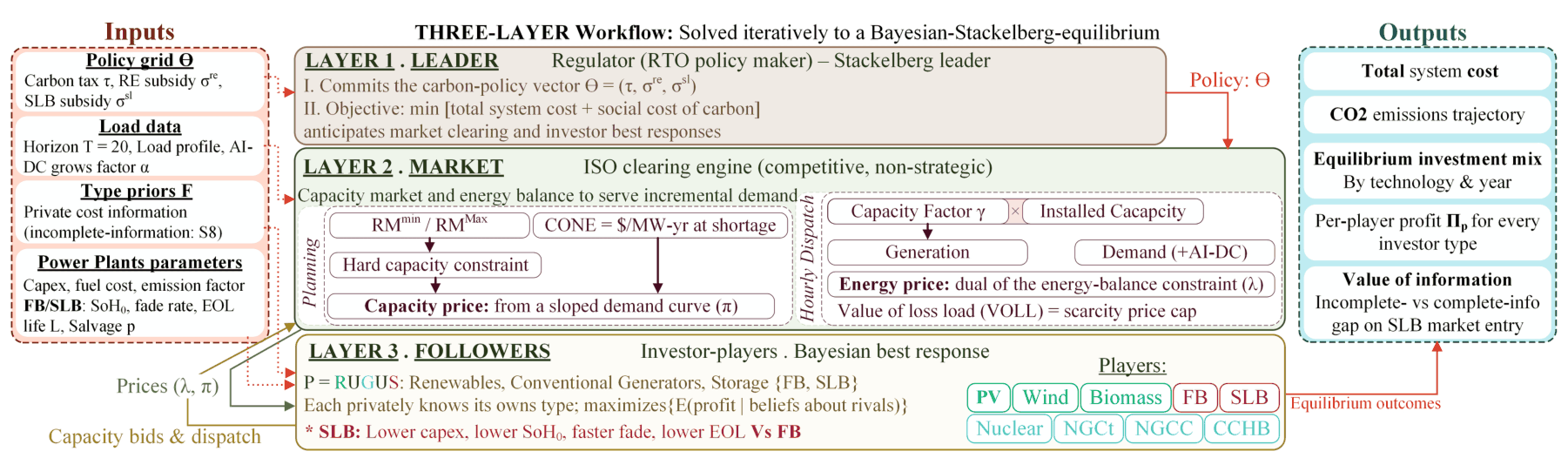
The NAPS 2026 paper builds a three-level Stackelberg–Bayesian game. A regulator sets carbon penalties and subsidies, an ISO capacity market clears against a generation-expansion energy balance, and technology-specific investors decide capacity and operation under incomplete information, yielding a Bayesian Nash equilibrium. AI load growth enters as an additional growth factor on a greenfield expansion, and SLB storage competes with first-life storage for capacity revenue. The model quantifies how a carbon tax, a renewable subsidy, and an SLB subsidy reshape the investment mix, emissions, and profit.
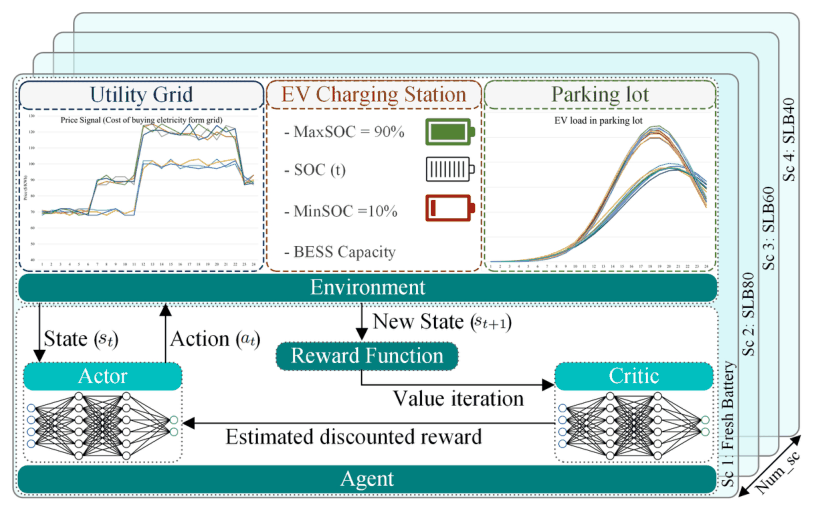
The PESGM 2025 paper presents a deep-reinforcement-learning planning framework for EV charging stations with SLB-based battery storage. A soft actor-critic agent is trained on a year of data, covering seasonal variation, weekdays, and holidays, with a tailored reward that allows real-time operation under uncertain EV arrival and departure times and variable grid prices.
Figure 2. Three-layer Stackelberg–Bayesian game: a regulator, an ISO capacity market, and technology-specific investors, with second-life batteries competing for capacity revenue.
Source: 2026 North American Power Symposium (NAPS), 2026.
R. Haghighi, A. Hassan, S. Mohammadi, M. C. I. Wada, and W. Su
Conference paper · 2026 North American Power Symposium (NAPS), 2026 Accepted
Abstract
Artificial intelligence (AI) data centers are driving rapid electricity load growth across all U.S. ISO/RTO regions, raising both system costs and carbon exposure. This study develops a three-level Stackelberg--Bayesian game in which a regulator (leader) sets carbon penalties and subsidies, a single ISO capacity market clears against an energy balance modeled as a classical generation-expansion problem, and technology-specific investors (followers) decide capacity and operation under incomplete information, yielding a Bayesian Nash equilibrium. The AI impact is captured parsimoniously as an additional load-growth factor on a greenfield-incremental expansion, isolating how much new capacity the growth pulls in and which technology fills it. Within this framework, we consider second-life battery (SLB) storage competing against new/first-life storage for capacity-market revenue. We quantify how a carbon tax, a renewable subsidy, and an SLB subsidy reshape the equilibrium investment mix, carbon emissions, and profit. Different scenarios are compared at the end based on cost-effectiveness and reduced carbon emissions.
R. Haghighi, A. Hassan, V.-H. Bui, A. Hussain, and W. Su
Conference paper · 2025 IEEE Power & Energy Society General Meeting (PESGM), pp. 1–5, 2025
Abstract
The rapid rise in electric vehicle (EV) adoption presents significant challenges in managing the vast number of retired EV batteries. Research indicates that second-life batteries (SLBs) from EVs typically retain considerable residual capacity, offering extended utility. These batteries can be effectively repurposed for use in EV charging stations (EVCSs), providing a cost-effective alternative to new batteries and reducing overall planning costs. Integrating battery energy storage systems (BESS) with SLBs into EVCSs is a promising strategy to alleviate system overload. However, efficient operation of EVCSs with integrated BESS is hindered by uncertainties such as fluctuating EV arrival and departure times and variable power prices from the grid. This paper presents a deep reinforcement learning (DRL)-based planning framework for EV charging stations with BESS, leveraging SLBs. We employ the advanced soft actor-critic (SAC) approach, training the model on a year's worth of data to account for seasonal variations, including weekdays and holidays. A tailored reward function enables effective offline training, allowing real-time optimization of EVCS operations under uncertainty.